Part 1 of the series Photography at the Edge of Perception: Explorations in Seeing Beyond Solid Form
Since the introduction of digital photography in the 1990s, the medium has evolved from a documentation tool into a field of wide-ranging exploration. Alongside advances in cameras and image processing, photography has increasingly become a way to examine perception itself—how we see, and what becomes visible when we move beyond strictly physical habits of looking.
My own photographic work grows out of a long-standing inquiry into the existence of other realms that coexist with our human one. Photography, particularly digital photography, has become one of my most reliable tools for exploring and visually documenting these layered realities.
This article opens the series Photography at the Edge of Perception, which examines photographic practices that expand perception beyond conventional, three-dimensional seeing. Across the series, I explore techniques such as manual exposure, which allows full control over light and timing; infrared photography, which reveals wavelengths beyond ordinary human vision; macro photography, which brings very small structures into detailed focus; and zoom lenses, which shift perspective from distant to intimate within a series of images. Together, these approaches form a photographic vocabulary for documenting layered realities. Here, the focus is on ICM — Intentional Camera Movement.

Midnight in a Neon Forest – a tryptic – three ICM photos of a bald cypress forest at night, with holiday lights on. All created with an upward swipe of the camera, enhancing the natural feeling of this grove existing as an interdimensional portal.
What Is Intentional Camera Movement?
Intentional Camera Movement involves moving the camera during an exposure rather than holding it completely still. Instead of prioritizing sharp edges and precise detail, ICM emphasizes motion, rhythm, and energetic flow. The resulting images often feel fluid and atmospheric, registering movement and transition rather than fixed form.
This method aligns with familiar perceptual experiences. When the eyes soften, the head turns quickly, or movement is detected at the edges of vision, the world loosens its solid outlines. In these moments, perception shifts. Additional layers of activity become accessible.
ICM brings this mode of seeing directly into photographic practice.

Inside the Neon Forest. Another ICM view of the same bald cypress grove. An upward swipe of the camera, emphasizing the feeling of a translucent veil between dimensions
Movement as a Gateway to Perception
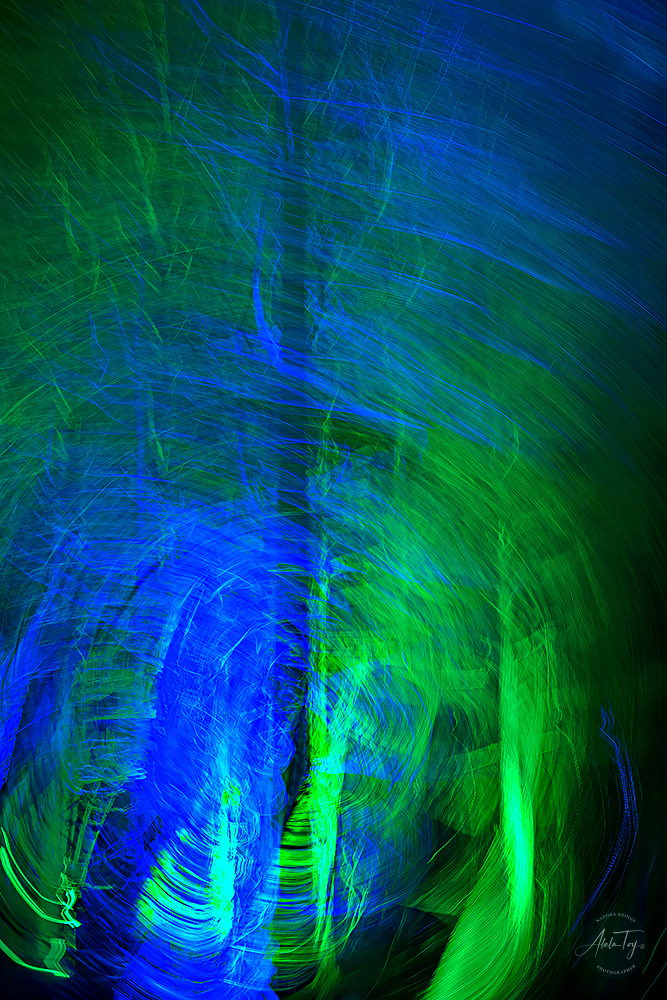
Circular ICM movement creating a dark central portal and an electric blue guardian. Swirled around a nural portal area of the crove
Across cultures and throughout history, humans have developed ways to move beyond ordinary perception. The recognition that perception can expand—that the world contains more than what is immediately apparent—has driven exploration in science, philosophy, athletics, medicine, and space travel. Curiosity about what lies beyond the known is a constant in human experience.
ICM operates within this same impulse. By releasing the camera from strict stillness, the photograph begins to register movement between states rather than static objects alone. Light records as shimmer. Boundaries soften. The image documents transition.
Rather than describing a single moment, the photograph captures a process.
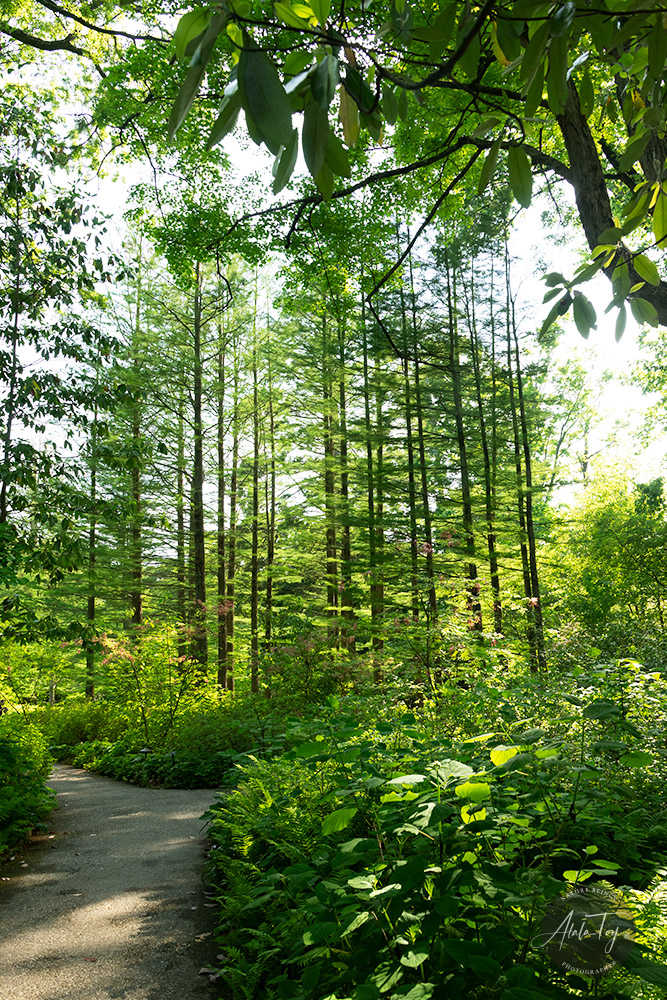
The same bald cypress grove in a stationary photo on a sunny summer morning. This is a favorite site of mine. The nature beings are very close to us in this area, and I have had many a lovely conversation with them.
Why I Use ICM
I am drawn to Intentional Camera Movement because it loosens the dominance of solid physicality and opens perception into a wider field. It closely parallels what I observe at thresholds between dimensions, where one frequency shifts into another and light carries information across states of being.
Photographing these moments makes transition visible and familiar. When movement becomes beauty, expanded perception feels accessible rather than distant. The resulting images form a visual language of connection, continuity, and coexistence.
The photographs that accompany this article demonstrate how ICM functions as a bridge—between motion and stillness, between form and energy, and between the world readily seen and the worlds that coexist alongside it.


Stunning method!!! Thank you for sharing it!!
Thanks so much, Traci. It is a very interesting technique indeed.
Atala this is an amazing concept ! Truly fascinating – I look forward to learning more. Thank you for documenting this topic and sharing with us!
Thanks so much, Joy. Love how we all are expanding our awareness. Best wishes to you on your own work in this field.